Showing posts with label vista. Show all posts

Saturday, September 26, 2009

AMD ATI Radeon HD5000 Series Windows 7 Direct X 11 graphic cards


If you don't already know by now, the next standard in gaming graphics is DirectX 11. This is found in Microsoft's upcoming Windows operating system, Windows 6.1, or more popularly known as Windows 7 (not because 6+1=7 or because Windows Vista was Windows 6.0, but because Microsoft says this is the seventh release of Windows).

DX11 adds some new features and one of them is Direct Compute, using the new Compute Shader element, which adds to the previous Geometry Shader which was introduced in DirectX 10 (Unified Shader Model 4) on Vista, and the Pixel and Vertex Shaders, which were introduced in DirectX 9 (Shader Model 3) prior to that in Windows XP.

Direct Compute is an implementation of GPGPU technology. Basically it uses your graphic card for processing instead of just your processor, thereby giving you extra performance. This can also be used for 3D Ray-Tracing and Video Transcoding. But did you know DX11 can work with DX10?


Unlike DX10 which required either AMD's ATI Radeon HD2000/3000/4000 series, or NVIDIA GeForce 8/9/200 series of DX10 gaming cards, DX11 can function on DX10 gaming cards as well, albeit not as fully as on DX11 gaming cards, which is the ATI Radeon HD5000 series, or NVIDIA GeForce 300 series (which isn't out yet).

As expected, this means DX11 can also work on Vista, and it can, when Microsoft releases the Vista Platform Update, but like the above DX11 and DX10 compatibility, you won't get the full features as compared to a pure DX11 platform, which is Windows 7 with DX11 gaming card, and in this case, only ATI's HD5000 is out. With this, coupled with Windows 7, you'll get the full DX11 deal. See here for a list of upcoming DX11 games.

Of course, with DX11 you can also play DX10 games, and you can see a list of DX10 games here - but remember to update your DX files! If you haven't done so, you can get it for free from Microsoft's site here (100MB). Even if you're using Windows XP with DirectX 9, it will update your files to the latest DX9. This might help if you're having problems running some games.

More Data?

Tuesday, July 14, 2009

x86 (32-bit) and 4GB of Memory


This might be something you already know - or don't. x86 (32-bit) computer systems can only recognise up to 4GB of total memory - regardless of what type of memory. This includes the DDR1, 2, or 3 memory modules slotted on your board inside the computer casing, as well as the memory (usually GDDR3, 4, or 5) that comes with your graphic card (which contains the GPU or Graphics Processing Unit) - if you have one installed.

Some boards come with integrated GPU so the memory is shared from the main installed modules. For these, there is no need to take the graphic card memory into consideration. But what if you have a graphic card?

If you have a graphic card, and say it comes with 512MB of memory, plus you have 4GB of memory sticks installed on your board, you will only be able to use about 3.5GB of memory because the other 512MB has to be allocated for the processor to access on the graphic card. This is a limitation of x86 design.

To circumvent this problem you have to move to x64 (64-bit), which means you have to install an x64 operating system (OS), like Windows XP 64 (rare), Windows Vista 64, or the upcoming Windows 7 64 - currently available as a freely-downloadable RC (Release Candidate) version from Microsoft's site here.

Keep in mind to use an x64 OS, your processor needs to be able to support x64 as well - check Intel or AMD's site (depending on which brand of processor you have) to see, or see here to see what processors support x86 and x64 OSes.

There is one caveat to using an x64 OS however - only x86 software can run on it (this backwards compatibility is included), and this means there can be no legacy 16-bit code in the x86 software, which can sometimes happen to older hardware which have outdated software.

x64 also means you can go beyond 4GB of board memory - so feel free to install more up to how much your board supports and if you can afford it. Having more memory means you can have more things open on your desktop without having to close something to free up memory for something else to open.

Keep in mind memory on the board and memory in the form of hard drive storage is 2 very different things. The board memory dictates how much you can open on your desktop at any one time while your drive storage dictates how much you can keep on your computer. There is a dual-stage of storage and usage going on between drive and memory so they're not the same.

More Data?

Tuesday, July 7, 2009

Sun Virtual Box 3 for 3D

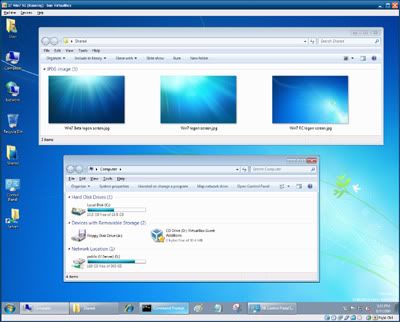
Sun Virtual Box 3 Windows 7 RC
That's Windows 7 RC running in Sun's Virtual Box 3 window (on a Windows XP desktop)

If you've read this post before (scroll down to the bottom of it), you'll know about Sun's Virtual Box (VB), a virtualisation software like Microsoft's Virtual PC 6 (VPC6), which is designed for Windows XP and Windows Vista.

Virtual PC 7 (VPC7) is designed for Windows 7, but unlike VPC6, VPC7 is designed to work transparently on Win7 as a compatibility feature for Windows XP software, hence it's known as "XP Mode". If VM (Virtual Machine) software sounds familiar, you might have heard of VMware before. But what's the difference?

VB differs from the popular VMware by being free, and it differs from MS VPC6 by emulating better computer hardware (since it's newer), and like VPC7, it offers a "Seamless Mode", where you can hide the virtual desktop running in VB and use the virtual windows with your actual operating system (OS). VMware calls this the "Unity Mode".

Anyway, since VPC7 only works on Win7 and only runs XP, this makes VB an attractive option if you're running XP, Vista, Mac or Linux, and if you want to run virtual Vista, Linux, etc.

Additionally, VP7 requires your processor to support hardware virtualisation (known as VT in Intel and V in AMD). If you have an Intel Core i-class or an AMD Athlon-class or AMD Phenom-class processor, it's ready. If it's an Intel Core 2-class or Intel Pentium 4-class processor, it may or may not. Check the Intel Archive Site here to see the list.

Moving on, in our previous VB post, we talked about using VB2 to sample Win7 RC (Release Candidate) instead of installing 7RC on your computer. However, VB2 suffers from one major flaw - while it emulates newer hardware than VPC6 which uses older hardware, it doesn't support 3D, in the form of Microsoft's Direct 3D - the most important component in DirectX for Windows, and OpenGL (Graphics Library), used in Mac and Linux.

VB3 solves that by including 3D support - albeit it's experimental. With VB3, you can now take full advantage of the newer emulated hardware - just like how VB2 did, except now you have 3D.

In our following post, we'll show you how to use these free VM software. In the meantime, feel free to play around with them. Remember, they're virtual. So whatever happens in them happens in the virtual OS - NOT the OS which these VM software runs on. So relax. You're safe.

This also means you don't have to bother with anti-virus or almost any forms of security. Hence why most anti-virus won't even work in a virtual OS. Which means using a virtual OS is a very secure way to experiment with any dangerous software which might otherwise wreak havoc on your actual OS. Using virtualisation is a good way to visit unknown sites which might otherwise harm your computer with your actual OS. However keep in mind you can share files between the virtual OS and your actual OS so make sure your actual OS has an updated anti-virus! We'll show you how to share files between the virtual (guest) OS and your actual (host) OS next time.

Free Virtualisation Software Download Links:
* Virtual PC 7 requires 2 install steps - the VPC7, followed by a virtual XP image (included)

More Data?
Monday, June 22, 2009

Best Free Antivirus?

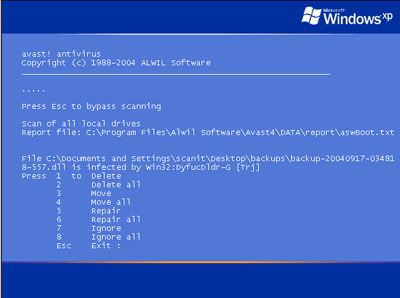
Avast Antivirus Bootscan

If you're looking for the best free antivirus out there, there's nothing better than Avast, made by Alwil. Not only does it support x64 (64-bit) operating systems (Windows XP or Vista), it also supports Linux, and comes with boot scan capability, which is very important if you have a virus or worm on your computer, as this ability eliminates the malicious program before it even loads when the OS starts up.

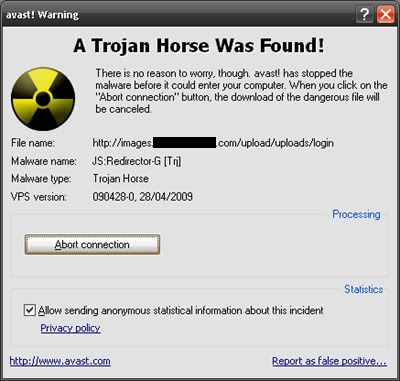
Avast works for a year - all you need to do is register on their site. Avast can also remove infections from USB flash drives (but please right-click and scan the drives in your My Computer first before opening it - you might have to do this a few times to fully get rid of it), and trojans. Did you know you can also customise the look of it?

Avast Antivirus Trojan

If you like to skin your AV software, Avast has a selection of skins here. Choose from Bionic for a BioHazard look, LCARS for Star Trekkies/Trekkers, Corporate if you're tech support installing for offices, Matrix for Neo fans, aVist if you're using Vista and want the AERO feel, and even KDE for Linux fanboys.

And yes, Avast is recognised by XP and Vista's Security Center so it will notify you when it's outdated so you can manually update it should the automatic update not execute (perhaps your connection was down at the scheduled time). Anyway it's always a good idea to manually update your security software off and on for any updates it may have missed during automatic updates.

A word of advice, an AV - or any AV for that matter - is a prevention tool more than a solutions tool. Meaning you need to take measures to scan the unknown before opening, not use your computer as usual and expect the AV to solve a virus once you're infected. Virii are designed to disable AV - trying to remove one once you're infected can be a hassle.

You can get Avast 4.8 from here (XP/Vista 34MB) and then register here. For more download languages, visit here. Linux users can download it here. Check out its features compared to others here.

More Data?

Monday, June 15, 2009

Sims 3 and Microsoft .NET Framework

Sims 3 logo

If you've read our latest BrickGamers LEGO® Gaming Comic, you'll notice we poke fun at Sims 3, or rather, the users (or players) of Sims 3 - which could be you! Are you one?

Microsoft .NET Framework logo

Anyway, since this is BrickTech, this is more about what goes on BEHIND Sims 3, in particular, Sims 3 requires Microsoft's .NET Framework (specifically version 2.0), a software framework that needs to be installed on Microsoft Windows XP operating systems but comes as a part of Microsoft Windows Vista (version 3.0) and of course, the RC (Release Candidate) of Microsoft Windows 7. But did you know you don't have to install the latest version of .NET to play Sims 3?

While the latest version of .NET is 3.5 Service Pack 1 (250MB), with .NET 4 Beta 1 in the works, Sims 3 was designed with .NET 2.0. This means if you're running Sims 3 on Vista or Win7 RC (yes it works!), the installer (or you) won't have to install any .NET versions, but if you're using XP, the installer will put in .NET 2.0, unless you've already installed .NET 3.0 or 3.5.

However, .NET will slow down your XP since it's adding a whole new software framework to an OS. Even version 1.0 and 1.1 of .NET needs to be installed on XP - it doesn't come with it. So the wise thing to do is to upgrade or run Vista (or even Win7 RC) instead, as it comes with .NET already. Of course you don't have to do this if you're not playing Sims 3 (or any other game or software which requires .NET). However, if you are, you're better off running the speedier Win7 RC or the slow Vista, rather than the slower XP with .NET.


More Data?
Tuesday, June 9, 2009

Vista Service Pack 2

If you're using Windows Vista, Service Pack 2 is out recently. If you've never installed Service Pack 1 on your Vista before, you can skip SP1 and go to SP2 directly. SP2 corrects any bugs and problems that have come out since SP1. To download Vista SP2 (350MB), you can get it directly from Microsoft's site via this link. Alternatively, you can get it from Microsoft's page here. But did you know there's 2 versions of SP2?

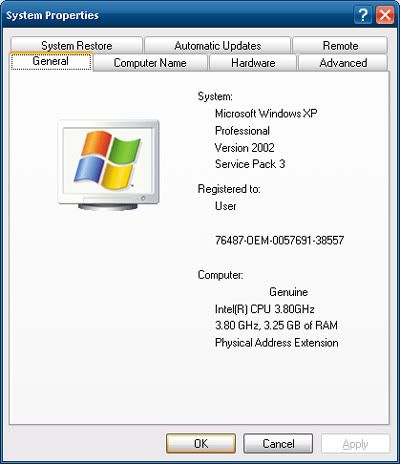
That's for the x86 (32-bit) version. If you're using the x64 (64-bit) version, you can get it here (570MB). The direct link is here. To know if you're using the 32 or 64 version, just right-click your Computer icon on your Vista Desktop and select Properties. Chances are if you have less than 4GB of memory, you'll be using the 32 version. 64 only works well once you got more than 4GB of memory as 32 can only use up to 4GB of memory.

More Data?